Most teams review VODs the same way: someone shares a screen, the whole game plays at 1.5x speed, everyone talks over each other, and an hour later nobody remembers what was decided. Then the same round happens again on Thursday.
A team review works when it is short, prepared and ends with a few jobs that someone owns. This guide gives you a 45-minute format, the order in which to look at things, a template to copy, and a worked example.
What a team review is for
A review compares what the team believed happened with what the recording shows. In the moment, five players each see a fifth of the round. On the recording, you can see why the rotation was late, who had information and didn't share it, and whether the plan was wrong or simply not played.
It is not:
- a full rewatch of the game (you won't learn more from round 23 than from the three rounds that decided the half);
- a place to settle who is the worst player;
- a mechanics lesson. Aim and movement are better worked on alone, with a coach or in the Range.
Getting the footage
Valorant replays
The client records replays of your matches. Riot's replay FAQ (June 2026) says they play only inside the client, can't be uploaded or shared as a file, and don't last: they expire with the patch, and Riot gives a 21-day limit. Download the ones you want to review in the days after the match, from the end-of-game screen or your match history. Since patch 12.10 you can also watch your friends' replays from their Career page.
For scrims in custom games, the replay only exists if the lobby owner turned recording on in the custom options before the match, and again before each new game (patch 12.10). Put it on the host's checklist, or you will have nothing to review.
Screen recordings
If you want a video you can pause, cut and share in Discord, record it. OBS Studio is free and works on any PC; the NVIDIA app and AMD Software: Adrenalin Edition also record. Upload the file to YouTube as unlisted (only people with the link can watch) or keep it on a shared drive.
The most useful setup for a team is one recording from each player's point of view, or at least from the IGL and the player who was in the key fights. A replay can then fill the gaps.
Each player flags two or three moments
Before the session, ask every player to send two or three moments: round number, timestamp if they have one, and one line ("round 14, I had no idea where the rotation was"). This takes five minutes and saves twenty in the session, because the hard part of a review is choosing what to watch. The debrief right after a scrim is the natural moment to note them (see our scrims guide).
The 45-minute format
Our suggestion, to adapt to your team:
| Minutes | What happens |
|---|---|
| 0 to 5 | The lead states the goal of the review and lists the rounds you will watch (three to five, from the flagged list) |
| 5 to 35 | Round by round: watch once at normal speed, then again, pausing at the decision point |
| 35 to 45 | Summary: the pattern you saw, one to three homework items, who owns each one |
Three rules make it work:
- A fixed slot, not right after the match. Emotions after a loss make every round look like someone's fault. The next day is better.
- One person leads, another writes. Often the IGL or the coach leads. The writer fills in the template so the leader can keep watching.
- Stop at the decision point and ask before telling. "What did you see here?" gets a better answer than "you should have rotated".
What to look at, in order
Work from the team down to the individual. The first items affect every round; the last ones affect one duel.
- Patterns. The same situation going wrong in several rounds: late rotations, the same entry dying first, always saving too late.
- Decisions at key moments. The entry, the mid-round call, the retake, the save. Was the call right with what you knew then?
- Utility. Not only whether it was used, but when: a smoke that lands two seconds after the entry is a smoke wasted.
- Positions and trades. Who could trade whom, and was the second player close enough?
- Economy. Buys that left you broke for the next two rounds, forces that made sense, and ones that didn't.
- Comms. Who called, how fast, and whether the information was usable ("one A long" is; "they're there" isn't).
- Individual mechanics. Last, and briefly. Note it and let the player work on it alone.
The template (copy it)
Paste this into a doc, a Discord thread or a note-taking app. A spreadsheet version is available as a CSV file: download the VOD review template (opens in Google Sheets, Excel or LibreOffice).
VOD REVIEW | [date]
Match: [scrim / Premier / league] vs [opponent] | Map: [map] | Score: [13-9]
Started on: [attack / defense] | Link: [video URL]
Led by: [name] | Notes by: [name]

Goal of this review (one sentence):

ROUND [n] | [timestamp]
- What we intended:
- What happened:
- Category: decision / utility / position / comms / economy / mechanics
- Players involved:
- Fix:

(3 to 5 rounds)

TALLY
decision [ ] utility [ ] position [ ] comms [ ] economy [ ] mechanics [ ]

HOMEWORK (1 to 3)
1. [what] | owner: [name] | check at: [next scrim, rounds x to y]
2.
3.
The tally is the part teams skip, and the most useful one over time. If "comms" wins three reviews in a row, your next practice block is about calls, not aim. Read it next to your scrim results: what to log after every scrim covers the numbers side.
A worked example
The example below is fictional, written to show how the template fills in.
ROUND 17 | 31:40
- What we intended: on defense at A, our A long player holds with a delay
  utility and falls back to site on first contact. The C player rotates
  on the first call.
- What happened: A long dry-peeked the first contact and died first.
  The call came about five seconds later. The C player rotated after
  the plant, and the retake was 3 against 4.
- Category: decision (the peek), comms (the late call)
- Players involved: A anchor, C player
- Fix: on first contact at A long, call "A long contact, falling back"
  and fall back. The C player moves on that call, not on the plant.
And the homework that comes out of it:
1. Fall back on first contact at A long, with the call | owner: A anchor
   | check at: next scrim, defense rounds 14 to 20
At the next scrim, the writer of the last review watches those rounds and says in one sentence whether it happened. Homework that nobody checks is a suggestion.
Giving feedback that sticks
- Talk about the action, not the person. "The A long peek in round 17", not "you always peek".
- Ask first. The player usually knows what went wrong; let them say it.
- Keep a running list of repeated mistakes. When the same item appears in three reviews, it stops being a note and becomes a practice block.
- Keep individual criticism out of public channels. Team patterns go in the team channel; a player's habits are for the player and the staff.
Where to keep the notes
A shared doc is fine if someone keeps it tidy. What matters is that notes are tied to a moment in the video, that players can find what concerns them, and that last week's homework is visible when the next review starts.
On sharing: a scrim recording is for your team's review. Don't publish the other team's footage, comps or comms without asking them, even as a short clip.
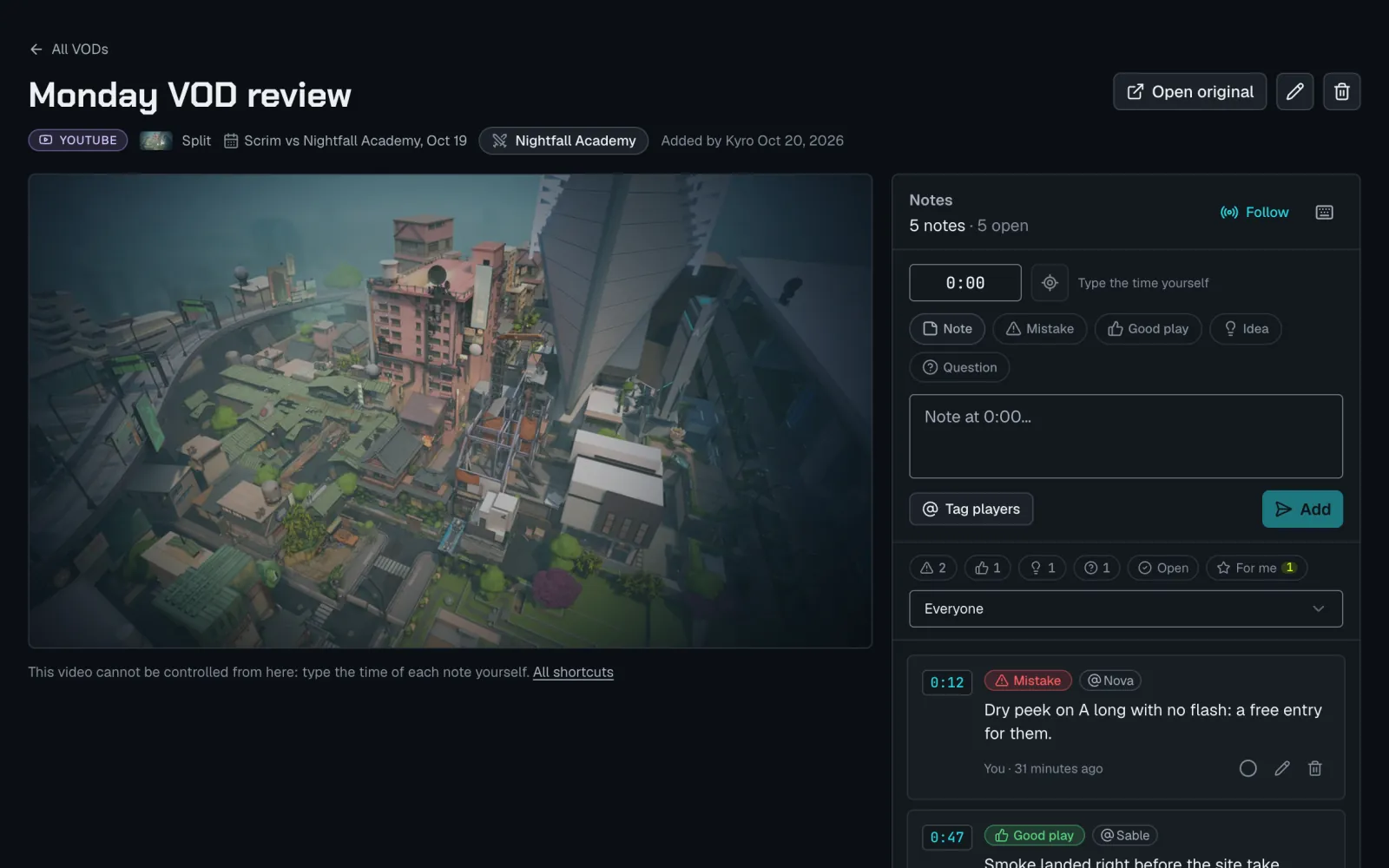
In Staq
In Staq you paste a YouTube or Twitch link and add notes at timestamps, each with a type (mistake, good play, idea, question) and the players it concerns; the team finds them in one place, and each player can filter what is about them. The free plan keeps one VOD review; Pro has no limit.